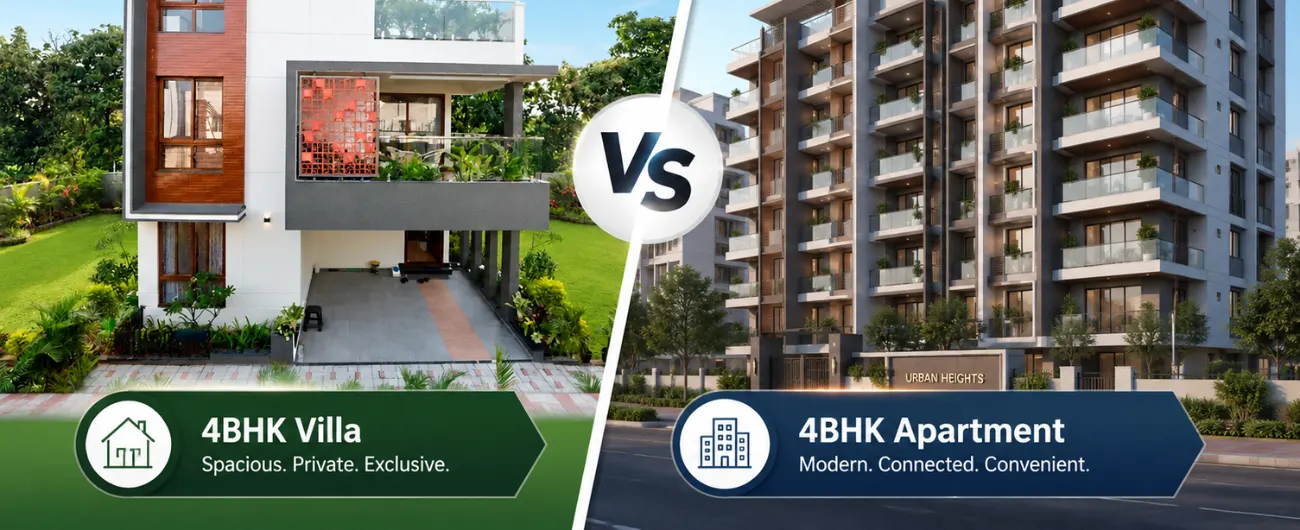
At the ₹2–3.5 Cr budget in Bangalore, you face a genuine fork in the road: a 4 BHK villa in a gated community, or a 4 BHK apartment in an established complex. Same family size, roughly similar price. But the investment case for each is fundamentally different.
Here’s the honest comparison — across price, rental yield, capital appreciation, resale, and lifestyle — so you can make the call based on your actual priorities.
Price Per Square Foot: Apartments Win on Paper
A 4 BHK apartment in Sarjapur Road or Whitefield typically costs ₹7,000–₹13,000 per sq.ft of super built-up area. A comparable 4 BHK villa in the same corridor runs ₹5,500–₹9,000 per sq.ft — seemingly cheaper.
But super built-up area in a high-rise apartment can have a loading factor of 30–40%, meaning you’re paying for lobbies, lift shafts, and corridors. A villa’s loading factor is typically 15–20%. The usable carpet area per rupee spent is usually better in a villa.
Add to this: villa ownership includes a share of land. Apartment ownership does not. Over a 10-year horizon, that land component becomes the dominant driver of value.
Rental Yield: Apartments Win Clearly
This is where apartments have a structural advantage — and it’s significant.
A well-located 4 BHK apartment near Whitefield or ORR commands monthly rentals of ₹60,000–₹1,20,000, translating to gross rental yields of 3–4.5% annually. Tenant demand from IT professionals is consistent, vacancy periods are short, and property managers understand the market well.
A 4 BHK villa in the same city rents for ₹80,000–₹1,50,000 — higher absolute rent, but against a higher purchase price, the gross yield works out to 2.5–3.5%. The tenant profile for villas is narrower — CXO-level professionals, senior expats, returning NRIs — which means longer vacancy periods between tenants.
Verdict: If rental income is your primary objective, a 4 BHK apartment in a well-located complex gives you better yield consistency than a villa. That said, if the villa is inside a well-managed gated community, the premium tenant profile can partially close the gap — read Gated Villas in Bangalore: Privacy Meets Smart Investment for a deeper look at how gated communities affect returns.
Capital Appreciation: Villas Win Over the Long Term
This is where the villa case strengthens considerably.
Sarjapur Road villa prices appreciated approximately 35–45% between 2021 and 2024, outpacing apartment appreciation in the same corridor. The driver is simple: land is finite. As Bangalore’s suburban corridors mature, the supply of well-located villa land shrinks while demand grows. Apartments, by contrast, can always be built higher — supply responds to demand more elastically.
Data from comparable markets supports this pattern: villa land values in infrastructure-driven corridors like Devanahalli have shown 10–15% annual appreciation over the last five years, ahead of apartment price growth in the same area.
The caveat: This advantage materialises over 7–10 years, not 2–3. If your horizon is short, apartments deliver more predictable returns.
Resale Liquidity: Apartments Win
When you sell, apartments are simply easier to exit.
A 4 BHK apartment in an established complex has a broad buyer pool — end users, investors, NRIs, and upgraders. Banks readily finance apartments, documentation is straightforward, and brokers have deep experience pricing and transacting them.
A 4 BHK villa has a narrower buyer pool. Buyers need larger budgets, lenders apply more scrutiny to villa financing (especially in corridors with Khata B or gram panchayat approval histories), and the transaction takes longer. When you need to exit quickly, this matters.
Verdict: If liquidity is important — because you may need to sell within 5 years, or because this is not your only asset — an apartment gives you a cleaner exit.
Lifestyle: Villas Win for Families
Investment numbers aside, the lived experience is genuinely different.
A 4 BHK villa gives you private outdoor space, no shared walls, no overhead footsteps, natural light on multiple sides, and the ability to modify your home without seeking approval from an RWA. For families with young children, elderly parents, or work-from-home professionals, this translates into a measurably better daily quality of life.
A 4 BHK apartment in a premium complex offers convenience — tighter security infrastructure, professional facility management, and urban proximity. But at the 4 BHK level, most buyers have reached a life stage where space and privacy matter more than convenience.
The Investment Verdict: Depends on Your Horizon
Factor | 4 BHK Villa | 4 BHK Apartment |
Price per usable sq.ft | Better | Higher loading |
Rental yield | 2.5–3.5% | 3–4.5% |
Capital appreciation (10yr) | Higher | Moderate |
Resale liquidity | Narrower pool | Broader pool |
Loan ease | More scrutiny | Straightforward |
Lifestyle (families) | Better | Convenient |
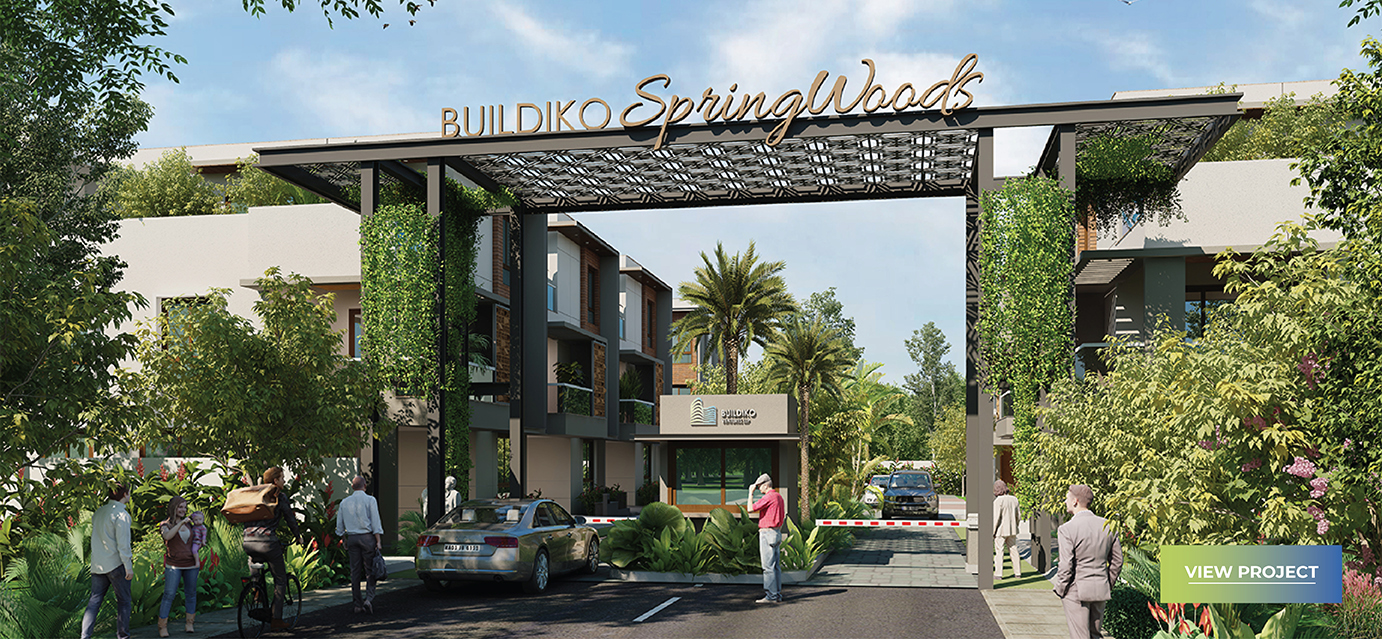
Buy the villa if: You have a 7–10 year horizon, you plan to live in it (or rent to premium tenants), and you’re buying in a corridor with clean legal approvals and a proven developer. Projects like Buildiko Springwoods on Sarjapur Road — with BDA/BBMP-aligned approvals, low density, and a RERA-registered track record — represent the kind of villa investment where the long-term case is strongest. Before you decide, read What “Premium” Should Actually Mean in a 4 BHK Villa to make sure you’re comparing like for like.
Buy the apartment if: You want stronger near-term rental yield, higher resale liquidity, and a shorter investment horizon. If you’re buying purely as an investment with no intent to live there, an apartment in an established IT corridor is likely to deliver more predictable returns over 3–5 years. Also worth reading before you decide: Under-Construction Villa vs Ready-to-Move: Which One Saves You More Money? — the UC vs RTM decision cuts across both asset types and significantly affects your all-in cost.
The smartest investors in Bangalore’s ₹2–3.5 Cr segment are increasingly choosing villas — not because apartments are a bad investment, but because at this budget and life stage, the villa offers something the apartment cannot: land, space, and a home that genuinely improves as the city grows around it.
This article is for informational purposes only and does not constitute financial or investment advice. Always consult a qualified advisor before making a real estate investment decision.