
Bangalore’s villa market has had a strong three-year run. Prices are up, demand is real, and developers are launching new projects across every major corridor. For anyone considering a villa investment in 2026, the question isn’t whether Bangalore is a good market — it’s whether now is the right time, which corridor makes sense, and what kind of returns are realistic.
Here’s an honest investment assessment based on current market data.
Where the Market Stands in 2026
Bangalore’s villa market has entered what most analysts describe as a “consolidation” phase in 2026 — not a boom, not a bust — after the sharp 2023–2025 run-up driven by post-pandemic demand, rising construction costs, and a wave of premium launches.
What that means practically: the 40–50% appreciation some corridors saw between 2021 and 2024 is behind us. Price growth is settling into something steadier — Coldwell Banker’s 2026 outlook puts average annual appreciation at 8–12% in established corridors, while broader city-wide estimates sit closer to 6–10%.
For investors, this is actually a healthier environment than the frenzy years. Appreciation is driven by fundamentals — IT employment, infrastructure, genuine end-user demand — rather than speculative buying. That kind of growth is more sustainable and more predictable.
The Bangalore villa market recorded more than 3,800 unit sales in FY 2025–26, with villas now commanding the highest per sq.ft rates of any residential asset class in the city at approximately ₹14,700 per sq.ft as of March 2026.
The Investment Case for Villas Over Apartments
The core argument for villa investment over apartments comes down to one word: land.
Villa plots and gated villa communities give investors direct exposure to land value appreciation. When a corridor opens up near an IT park, metro line, or major arterial road, early-stage villa developments often see a sharp jump as infrastructure, schools, and retail come in. Apartments don’t share in this land appreciation the same way — developers can always build more floors, keeping apartment supply elastic. Land supply is finite.
Villas now command the highest per sq.ft premium of any residential format in Bangalore. This premium reflects the market’s recognition that well-located gated villas are a genuinely scarce product.
The trade-off: rental yields on villas (2.5–3.5%) are lower than apartments in IT corridors (3–4.5%) — apartments tend to attract more consistent rental demand from a broader tenant pool. If rental income is your primary objective, apartments often deliver more predictably. If capital appreciation over 7–10 years is the goal, villas have historically outperformed.
Which Corridors Offer the Best Investment Returns in 2026
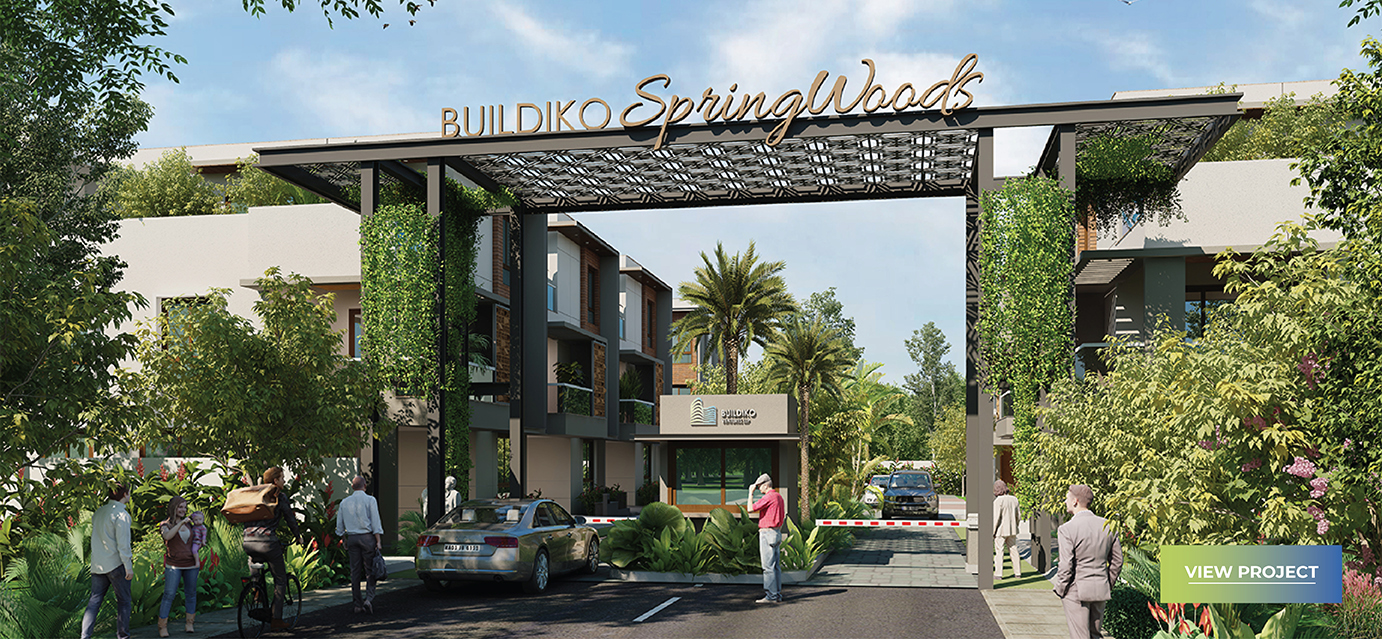
Sarjapur Road — Established Appreciation Play The Sarjapur Road belt has seen 10–12% annual appreciation over the past three years on the back of IT campuses like RMZ Ecoworld and Cessna Business Park. This is the most liquid villa market in Bangalore — easier to buy into, easier to exit. Projects like Buildiko Springwoods on Sarjapur Main Road represent the kind of RERA-registered, well-located gated community where the investment fundamentals are strongest.
Best for: investors who want liquidity and proven appreciation in an established corridor.
Devanahalli / North Bangalore — Infrastructure-Led Growth Airport expansion, the proposed aerospace SEZ, and improving road connectivity continue to drive demand in North Bangalore. The region offers three major advantages for investors: strategic mobility tied to airport growth, a tightening supply of quality gated villa product, and early-stage pricing that hasn’t yet caught up with infrastructure investment.
Best for: investors with a 5–7 year horizon who want to get ahead of infrastructure-driven appreciation.
Budigere Cross — Fastest Appreciating Corridor Properties in developing micro-markets like Budigere Cross show consistent appreciation and high rental demand. The corridor has attracted several large township projects and is seeing strong interest from HNI and NRI buyers.
Best for: investors comfortable with longer hold periods and willing to accept less liquidity in exchange for higher appreciation potential.
What Returns Are Realistic in 2026
Be honest with yourself about what to expect:
Capital appreciation: 6–10% annually across Bangalore, with established IT corridors like Sarjapur Road and Whitefield at the higher end of that range. Not the 15–20% some buyers experienced in 2022–23, but steady and compounding.
Rental yield: 2.5–3.5% gross on gated villa communities. Higher yields (4–5%) are available in apartment-heavy IT corridors like Electronic City and Kanakapura Road, but not typically in villa segments.
Total return: A well-chosen villa in an established corridor — combining 8–10% annual appreciation with 2.5–3% rental yield — can deliver a 10–13% total annual return over a 7–10 year hold. That compares favourably with most fixed-income alternatives and most equity real estate funds.
The risk is concentration — real estate is illiquid, and one property in one corridor is a concentrated bet. Understand what you’re doing before you commit.
What to Avoid
Chasing past appreciation. Corridors that delivered 40% in 3 years are unlikely to repeat that performance. Look for corridors where appreciation is driven by infrastructure coming in — not corridors where it already arrived and is now priced in.
Buying on approval risk. Gram panchayat-approved layouts, unclear land titles, and Khata B properties are common in the villa market. A property with approval issues will underperform regardless of corridor fundamentals. Clean legal status is non-negotiable for investment-grade villa assets.
Overestimating rental income. Villa rentals are lumpy — longer vacancy periods between tenants, smaller tenant pool, higher upkeep costs. Build your investment case primarily on appreciation, and treat rental income as a bonus rather than a core return driver.
The Bottom Line
Bangalore enters 2026 as a consolidation market — steadier, healthier, and more fundamentals-driven than the frenzy years. For villa investors with a 7–10 year horizon, the combination of land scarcity, IT employment growth, and infrastructure expansion across multiple corridors makes it a genuinely strong asset class.
The investors who do well here are the ones who buy the right product in the right corridor with clean approvals — not the ones who buy the cheapest option and hope the market does the work.
Before you invest, read Best Areas to Buy a 4 BHK Villa in Bangalore, 4 BHK Villa vs Apartment — Which Is the Smarter Investment?, and Total Cost of Buying a Villa in Bangalore.
This article is for informational purposes only and does not constitute financial or investment advice. Market data cited is sourced from publicly available research as of mid-2026. Always consult a qualified financial advisor before making any real estate investment decision.